What Happens When Your CCTV Camera Gets Hacked?
The Hidden Risks Businesses Can’t Ignore
Most businesses install CCTV cameras for one simple reason: to improve security.
But what happens when the device designed to protect your business becomes compromised?
A hacked CCTV camera isn’t just a technical problem. It can become a privacy, security, financial and reputational risk for your organisation.
Today, CCTV cameras are connected to networks, NVRs, cloud platforms, mobile applications and remote-access systems. That connectivity makes surveillance more convenient — but it can also create additional points of exposure.
The uncomfortable question every organisation should ask is:
If someone gained unauthorised access to our cameras today, what could they see, what could they learn and what could happen next?
Let’s look at the potential fallout.
1. Data Privacy Breach
Your CCTV cameras may be capturing much more than you realise.
Depending on where they are installed, surveillance footage can contain information about:
- Employees
- Customers
- Visitors
- Vehicles
- Business operations
- Entry and exit patterns
- Sensitive areas
- Security procedures
If an unauthorised person gains access to your camera feeds or stored recordings, that information could potentially be viewed, copied or misused.
The risk isn’t simply that someone can watch your camera.
The bigger issue is:
You may lose control over who has access to your surveillance data.
For businesses handling sensitive environments or large volumes of customer and employee activity, this can create serious privacy and compliance concerns.
2. Your Camera Can Become a Source of Intelligence for Criminals
Think about what your CCTV system sees every day.
It may reveal:
- When employees arrive and leave
- When a premises is empty
- Where valuable equipment is stored
- Which entrances are frequently used
- How security procedures operate
- When deliveries arrive
- Where restricted areas are located
Now imagine someone else having access to that information.
A compromised camera could potentially provide criminals with valuable visibility into your physical environment.
That information could potentially be used to facilitate:
Theft.
Break-ins.
Fraud.
Vandalism.
Unauthorised access.
Your CCTV system was installed to help keep criminals out.
You don’t want it becoming a source of information that helps them get in.
3. The Risk Can Extend Beyond Ordinary Crime
Surveillance systems are increasingly used across environments such as:
- Industrial facilities
- Warehouses
- Transport infrastructure
- Commercial buildings
- Critical facilities
- Public-facing locations
In these environments, cameras may provide visibility into sensitive locations and operational patterns.
If surveillance systems are poorly secured and compromised, attackers could potentially gather information that goes beyond individual privacy concerns.
For organisations operating in sensitive environments, this can create broader security and national-interest concerns.
A CCTV camera may look like a simple device.
But once it is connected to a network, cloud platform or other systems:
It becomes part of your digital attack surface.
4. Reputation Risk: Trust Can Disappear Quickly
Imagine your customers discover that your CCTV system has been compromised.
The technical explanation might be complicated.
Their reaction probably won’t be.
They may simply ask:
“Why wasn’t our information protected?”
A security incident can damage confidence among:
- Customers
- Employees
- Business partners
- Suppliers
- Investors
- The wider public
And reputation damage can be difficult to measure.
A technical vulnerability might be fixed in a day.
Rebuilding trust can take much longer.
5. Financial Risk
The cost of a compromised CCTV system isn’t necessarily limited to replacing cameras or resetting passwords.
A security incident can potentially result in:
- Investigation costs
- Cybersecurity remediation
- System recovery
- Business disruption
- Legal and compliance expenses
- Loss of customer confidence
- Increased security expenditure
- Potential claims or penalties
There is also another cost businesses often overlook.
What happens if someone uses information from your compromised cameras to plan a physical security incident?
If surveillance footage helps criminals understand your premises, operations or security routines, the resulting financial impact could be significantly greater than the cost of the original cyber incident.
6. The Most Dangerous Part? You May Not Know
This is one of the biggest concerns with CCTV security.
A compromised camera may continue to:
Record normally.
Display normally.
Look completely normal.
Meanwhile, unauthorised access could potentially be happening in the background.
That means waiting for something unusual to appear on the monitor isn’t necessarily enough.
Security needs to be proactive.
CCTV Security Is More Than Installing a Strong Password
Changing default passwords is important.
But modern surveillance security should go further.
Your CCTV environment may include:
Cameras → NVR/DVR → Network → Router → Cloud → Mobile Apps → Remote Users
Every connection needs to be considered.
A stronger approach combines:
Secure devices + controlled access + secure networks + updated systems + monitoring + regular security assessments
The goal isn’t simply to have cameras.
The goal is to have cameras that remain trustworthy.
Your CCTV Should Protect You — Not Become Your Weakest Link
This is where CamSecure by Tara comes into the picture.
CamSecure is designed to help organisations take a more proactive approach to CCTV and surveillance security.
Instead of asking:
“Are our cameras working?”
Businesses should also ask:
“Are our cameras secure?”
Because a camera that records perfectly but is exposed to unauthorised access can still represent a significant risk.
Don’t Wait for the Camera to Become the Incident
The question isn’t simply:
“Can someone hack my CCTV camera?”
The better question is:
“If someone gained unauthorised access, what could they see, what could they learn and what could they potentially do with that information?”
Because when a camera is compromised, the fallout may not stay inside the camera.
It can move through your:
DATA → OPERATIONS → SECURITY → FINANCES → REPUTATION
Your CCTV system was installed to reduce risk.
Make sure it isn’t creating a new one.
CamSecure by Tara
Know your CCTV security risk. Protect your surveillance environment. Protect your business.
Frequently Asked Questions
Can CCTV cameras really be hacked?
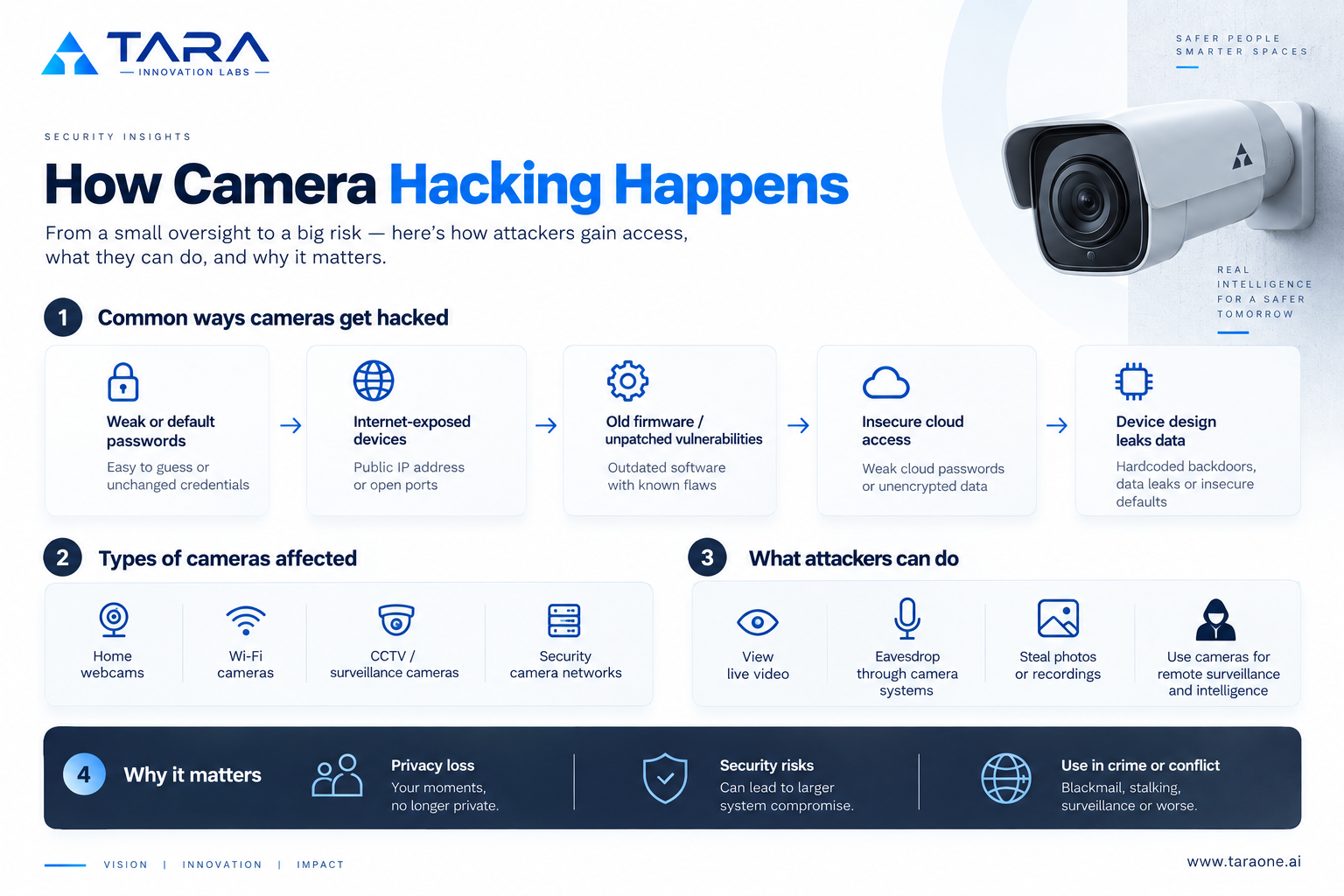
Yes. Internet-connected CCTV cameras and surveillance systems can be exposed to cyber threats. Weak passwords, outdated software, insecure remote access and poorly protected networks can increase the risk.
What happens when a CCTV camera is hacked?
Depending on the system and level of access obtained, an attacker may potentially view live footage, access recordings, change settings or interfere with camera functionality.
Can a hacked CCTV camera put my business at risk?
Yes. A compromised camera may reveal information about employees, customers, valuable assets, operating hours, security procedures and physical locations. That information could potentially increase security risks.
Can CCTV hacking cause a data privacy breach?
Potentially. CCTV footage can contain information about identifiable individuals and business activities. Unauthorised access or disclosure of that footage can create privacy and compliance concerns.
Can criminals use hacked CCTV cameras to plan a break-in?
Potentially. If criminals gain access to surveillance footage, they may be able to observe patterns such as occupancy, access points, employee movements and security routines. This information could potentially be misused.
How do I know if my CCTV has been hacked?
There may be warning signs such as unexpected camera movements, unfamiliar users, unexplained configuration changes, unusual network activity or unknown devices accessing the system. However, a compromise may not always be obvious.
Is changing my CCTV password enough?
Changing default or weak passwords is essential, but it should not be the only security measure. CCTV security should also consider firmware, network configuration, remote access, user permissions and connected devices.
Are wireless CCTV cameras more vulnerable?
Wireless connectivity does not automatically make a camera insecure. However, improperly configured wireless networks, weak authentication or insecure remote access can increase exposure. The security of the entire surveillance environment matters.
Why is CCTV cybersecurity important for businesses?
Because modern CCTV systems are connected devices that collect, process and transmit information. A compromise can potentially create both cybersecurity and physical security risks.
How can I check whether my CCTV system is secure?
Businesses should review camera access, passwords, firmware, remote-access settings, network configuration, connected devices and user permissions. A professional CCTV security assessment can provide a more comprehensive understanding of potential vulnerabilities.
What is CamSecure by Tara?
CamSecure by Tara is a CCTV security solution designed to help organisations take a proactive approach to protecting their surveillance environment and identifying potential security risks.
Is Your CCTV Protecting Your Business — Or Exposing It?
Don’t wait for a compromised camera to become a costly security incident.
Understand your CCTV security risk with CamSecure by Tara.