AI CCTV vs Traditional CCTV: What’s the Real Difference?
For years, CCTV cameras have been a standard part of business security. They record what happens and provide footage that can be reviewed when an incident occurs.
But modern surveillance is changing.
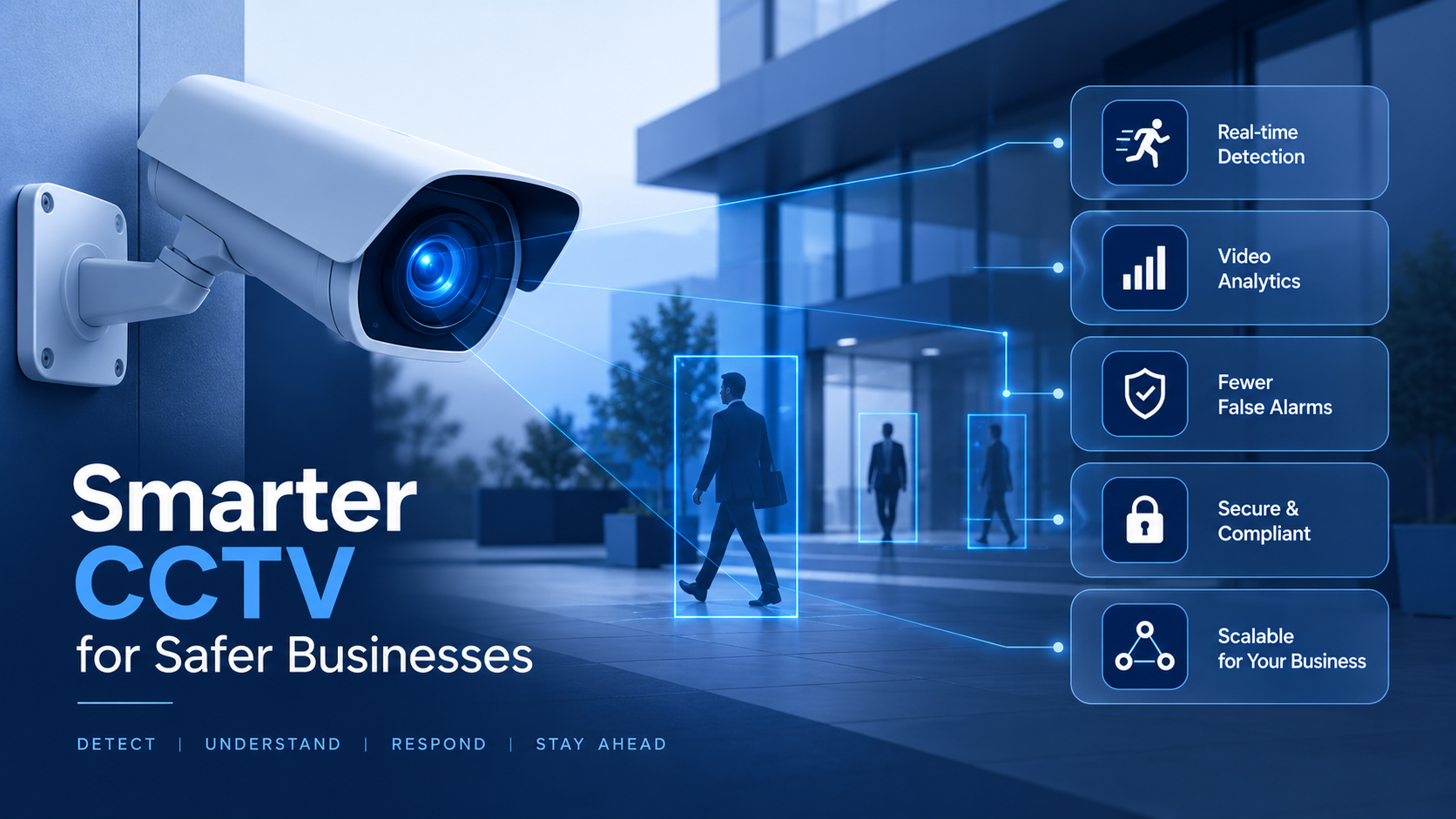
With AI-powered CCTV and video analytics, cameras can do much more than simply record video. They can identify people and vehicles, detect unusual activity, generate real-time alerts, and help security teams respond faster.
So, what is the real difference between traditional CCTV and AI CCTV? And which one is right for your business?
Let’s break it down.
What Is Traditional CCTV?
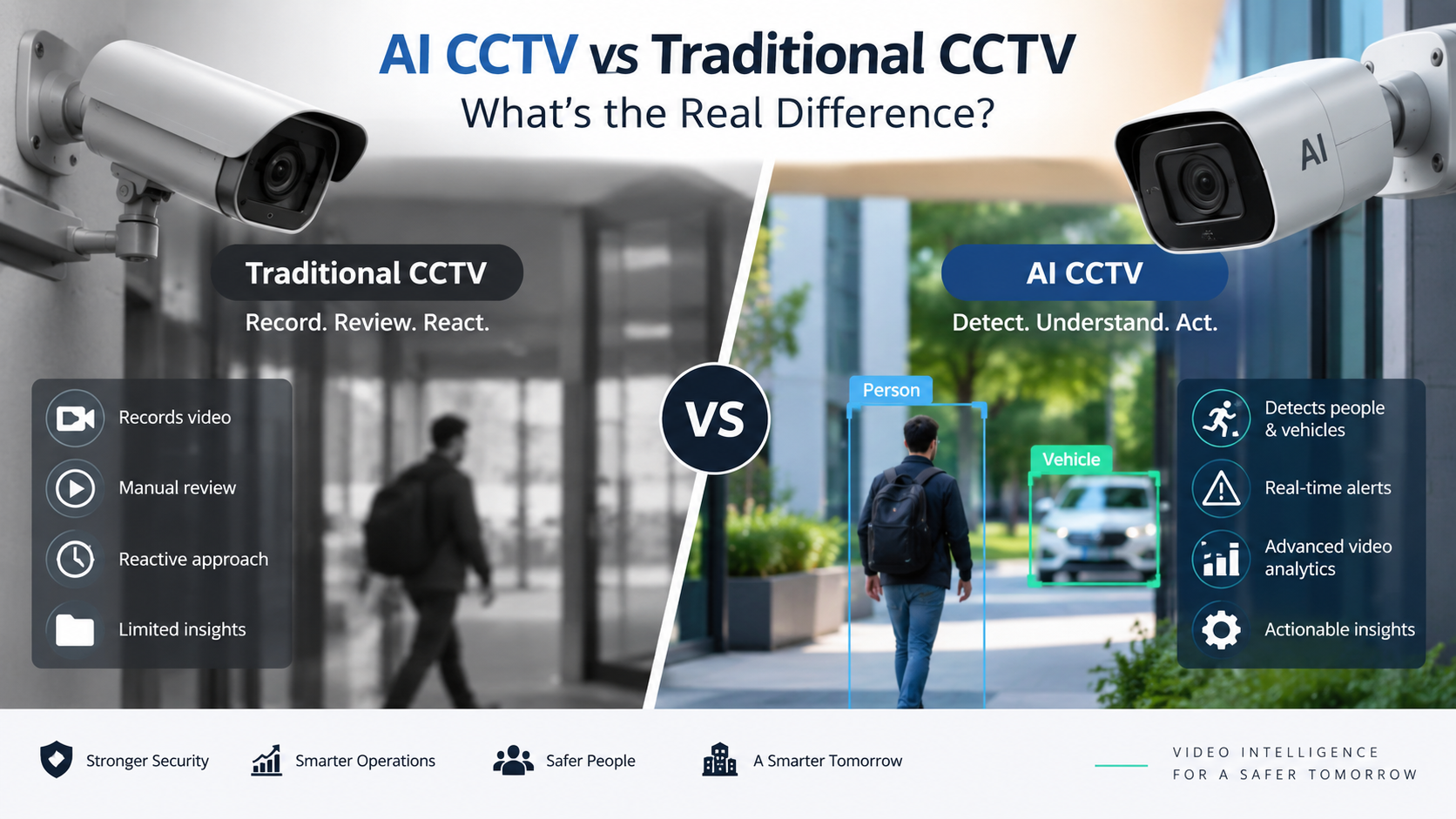
Traditional CCTV is primarily designed to capture and record video.
A typical system includes cameras, an NVR or DVR, storage, monitors, and networking equipment. The cameras continuously record footage, which can later be viewed by security personnel.
For example, if something is stolen from a warehouse at 2:00 PM, a security team may need to search hours of recorded footage to find out what happened.
Traditional CCTV is useful, but it generally depends on a person to watch the screens or review recorded footage.
Traditional CCTV can help with:
- Recording security footage
- Reviewing past incidents
- Monitoring entrances and exits
- Deterring unwanted activity
- Investigating theft or vandalism
- Maintaining visual records
The limitation is simple: the camera records what happens, but it doesn’t necessarily understand what is happening.
What Is AI CCTV?
AI CCTV combines cameras with artificial intelligence and video analytics.
Instead of treating every frame of video equally, AI-powered systems can analyze what the camera sees and identify specific events or patterns.
For example, an AI system could detect:
- A person entering a restricted area
- A vehicle entering after working hours
- Someone crossing a virtual boundary
- A person loitering in a particular area
- A crowd forming in an unusual location
- An object being left unattended
- A vehicle moving in the wrong direction
- People entering or leaving an area
- Safety equipment compliance, depending on the analytics solution
When a relevant event occurs, the system can generate an alert so that the security team can respond.
This changes CCTV from a passive recording system into a more proactive security and monitoring platform.
AI CCTV vs Traditional CCTV
| Feature | Traditional CCTV | AI CCTV |
|---|---|---|
| Video recording | ✅ Yes | ✅ Yes |
| Live monitoring | ✅ Yes | ✅ Yes |
| Search recorded footage | Manual | AI-assisted options available |
| Motion detection | Basic | Advanced analytics |
| Person detection | Limited/basic | ✅ Yes |
| Vehicle detection | Limited/basic | ✅ Yes |
| Intrusion detection | Basic/manual | ✅ AI analytics |
| Line crossing | Basic | ✅ Advanced |
| People counting | ❌ Usually unavailable | ✅ Yes |
| Loitering detection | ❌ | ✅ |
| Crowd detection | ❌ | ✅ Depending on solution |
| Real-time intelligent alerts | Limited | ✅ Yes |
| Business intelligence | ❌ | ✅ Depending on analytics |
| Human monitoring required | High | Lower for specific events |
| Proactive response | Limited | ✅ Better suited |
The exact capabilities depend on the camera, software, analytics engine, installation and configuration.
The Biggest Difference: Detection vs Understanding
The most important difference isn’t simply that one camera has AI and the other doesn’t.
It’s what happens after the video is captured.
Imagine a warehouse with 30 cameras.
A traditional CCTV system may record all 30 cameras continuously.
If an incident happens, someone has to go through the footage and identify the relevant event.
With AI video analytics, the system can be configured to look for specific events.
For example:
“Alert me if someone enters this restricted area outside working hours.”
Instead of waiting for an incident and reviewing footage afterward, the security team can receive an alert when the defined event occurs.
That can significantly reduce the time required to identify and respond to certain security events.
5 Practical Examples of AI CCTV in Business
1. Intrusion Detection
Suppose a factory has a restricted zone that should only be accessed by authorized personnel.
An AI video analytics system can create a virtual boundary around the area.
If a person enters the zone, the system can trigger an alert.
This is much more useful than simply recording the intrusion.
2. People Counting
Retail stores, offices, malls and other facilities can use video analytics to understand how many people enter and leave an area.
This can help businesses analyze:
- Footfall
- Occupancy
- Peak periods
- Queue conditions
- Store traffic patterns
In this case, CCTV becomes more than a security tool. It can also provide operational information.
3. Loitering Detection
Not every person standing in an area represents a security problem.
But if someone remains in a sensitive location for longer than a defined period, the system can identify the behavior and generate an alert.
This can be useful around:
- Warehouses
- Parking areas
- ATMs
- Restricted zones
- Building entrances
- Perimeters
4. Vehicle Analytics
AI video analytics can identify and track vehicles in supported environments.
Depending on the solution, businesses may use analytics for:
- Vehicle detection
- Number plate recognition
- Wrong-way detection
- Parking monitoring
- Restricted-area monitoring
- Traffic flow analysis
This can be particularly useful for factories, logistics facilities, parking facilities and large commercial properties.
5. Safety Monitoring
AI video analytics can also be used for workplace safety.
Depending on the cameras and analytics platform, systems can identify conditions such as:
- People entering hazardous areas
- Missing safety equipment
- Unsafe access to restricted zones
- Crowd or occupancy conditions
The objective isn’t to replace safety teams. Instead, analytics can provide another layer of monitoring and help teams respond to defined risks faster.
Does AI CCTV Replace Security Guards?
No.
AI CCTV should generally be viewed as a tool that helps security teams work more effectively.
A security guard may have to monitor dozens of cameras at once. Human attention naturally decreases when people are watching screens continuously for long periods.
AI analytics can monitor defined conditions continuously and notify the team when something relevant happens.
The security team can then investigate and decide what action is appropriate.
So the better model is:
AI detects → Security team verifies → People respond
rather than:
AI replaces people.
Is AI CCTV More Expensive?
The initial investment can be higher than a basic CCTV installation because an AI surveillance solution may require:
- AI-enabled cameras
- Video analytics software
- Processing hardware
- Appropriate networking
- Storage
- Licensing, depending on the platform
- System configuration and integration
However, the right comparison shouldn’t be based only on camera price.
Businesses should consider the overall value of the system.
For example, if AI analytics helps a security team identify incidents faster, reduce manual monitoring, improve safety or provide useful operational data, the additional investment may provide a meaningful return.
Can You Add AI to Existing CCTV Cameras?
In some cases, yes.
This is an important option for businesses that already have a CCTV infrastructure.
Depending on the existing cameras, resolution, compatibility, network architecture and analytics requirements, AI analytics may be implemented through:
- AI-enabled cameras
- Edge devices
- Server-based analytics
- Video management platforms
- Hybrid architectures
This means businesses don’t always have to replace their entire surveillance infrastructure to start using video analytics.
A proper assessment of the existing system is important before deciding which approach is suitable.
Traditional CCTV or AI CCTV: Which One Should You Choose?
It depends on your security requirements.
Traditional CCTV may be suitable when:
- You mainly need video recording
- Your security requirements are relatively simple
- You have a limited number of cameras
- You primarily need footage for investigation
- Advanced analytics aren’t required
AI CCTV may be a better option when:
- You need real-time alerts
- You have large premises
- Manual monitoring is difficult
- You need intrusion or perimeter analytics
- You want people or vehicle analytics
- You want to improve workplace safety
- You want to extract business insights from video
- You want to upgrade an existing surveillance system with intelligent analytics
The Future of CCTV Is Video Intelligence
CCTV is moving beyond the idea of simply asking:
“What happened?”
Modern video analytics can help businesses ask:
“What is happening right now?”
and, in some applications:
“Can the system alert us when a specific event occurs?”
That’s the real difference between traditional CCTV and AI-powered surveillance.
Traditional CCTV remains an important foundation for security. But when combined with AI video analytics, surveillance systems can become more proactive, automated and useful for day-to-day operations.
Looking to Upgrade Your CCTV System?
If your business already has CCTV or you’re planning a new surveillance installation, the first step isn’t necessarily to replace everything.
A better approach is to understand your security objectives, existing infrastructure, camera coverage and analytics requirements and then select the appropriate solution.
With the right CamSecure and video analytics solution, businesses can move from simply recording security footage toward a smarter approach to monitoring, detection and response.
Want to know what AI video analytics can do for your existing CCTV system? Contact our team for a surveillance assessment and discuss the right solution for your business.
Frequently Asked Questions
1. What is AI CCTV?
AI CCTV uses artificial intelligence to detect and analyze activity instead of only recording video.
2. What is the difference between AI CCTV and traditional CCTV?
Traditional CCTV records footage, while AI CCTV can detect people, vehicles, unusual activity, and specific events.
3. Can AI CCTV send alerts?
Yes. It can send alerts when a predefined event or activity is detected.
4. Can I add AI to my existing CCTV?
In many cases, yes. It depends on your existing cameras and system setup.
5. Does AI CCTV replace security guards?
No. It helps security teams detect and respond to important events faster.
6. Is AI CCTV worth the cost?
For businesses that need smarter monitoring and real-time alerts, AI CCTV can provide significant value.
7. Where can AI CCTV be used?
It can be used in factories, offices, warehouses, retail stores, schools, parking areas, and many other locations.
8. Which is better for my business: AI CCTV or traditional CCTV?
It depends on your needs. If you need intelligent detection and alerts, AI CCTV is usually the better option.